On the questions I pursue
Black holes are the most extreme prediction of Einstein’s theory of gravity, and for decades they could only be studied indirectly. Today, a telescope as large as the Earth can resolve the region right at their edge. That raises a simple question with a difficult answer:
What can we actually learn about the dark object at the centre of a galaxy by looking at it?
The difficulty is that we never see the object itself. What reaches us is light from hot gas swirling around it. That light has been bent by gravity, and then recorded by a telescope that captures only fragments of the picture. Every image is therefore three things mixed together: the shape of spacetime, the behaviour of the gas, and the limits of the instrument. When a prediction and an observation disagree, we cannot tell at first which of the three is responsible.
So the large question has to be broken into smaller ones, each narrow enough to be answered on its own, and taken in a sensible order.
1Spacetime: what kind of object is it?
Einstein’s theory allows black holes, but it does not insist on them. The same equations also describe collapsed objects with no event horizon, no point of no return. Seen from afar, both kinds can cast almost the same dark shadow. The question therefore becomes: if the shadow cannot tell them apart, what can? To answer it, I follow light through each kind of spacetime and simulate gas falling onto it, looking for the subtle places where the two pictures stop agreeing.
2The gas: what is shining, and how?
Before the shape of spacetime can be tested, the gas around it has to be understood, since different kinds of flow can draw the same bright ring. How is the gas moving? Is it orbiting or slowly falling in? How are its magnetic fields arranged? Each of these leaves its mark on the light, especially on its polarisation. Untangling them one at a time is what makes a test of gravity possible at all.
3The telescope: what does the data allow us to say?
The Event Horizon Telescope does not take a photograph. It links radio dishes across the planet, each recording a small piece of information, and the image has to be rebuilt from those pieces. Different ways of rebuilding it can produce slightly different pictures. So every feature in an image has to be checked: is it truly in the data, or did the method put it there?
4Time: from a single picture to a moving one
A single picture can often be explained in more than one way; a sequence is much harder to explain away. That is the idea behind TomoGrav: to follow how the gas moves in three dimensions over time, and so watch gravity at work instead of inferring it from one frame.
What it means to pursue them
The order matters. First the spacetime, then the gas within it, then the telescope that observes both. Only then can we say anything meaningful about what sits at the heart of a galaxy. Each step settles a question small enough to be decided. Together, they turn a question about the nature of black holes into a question about what our evidence can bear, and those are not quite the same.
Explainers
Each explainer tells the story behind one paper in plain language: the question, how we went about it, and what we found.
-
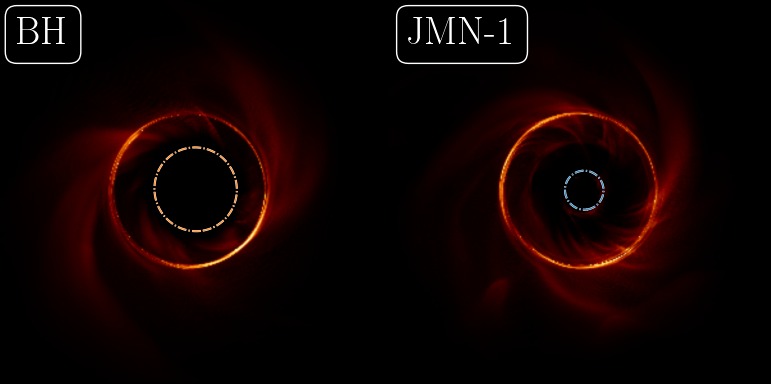 A Black Hole Without a Horizon?
Could M87* be a collapsed object with no event horizon? We ran the first 3D magnetised simulation of gas falling onto such an object. Its image looks almost identical to a black hole's, except for a faint glow from inside the shadow that future telescopes could see.
-
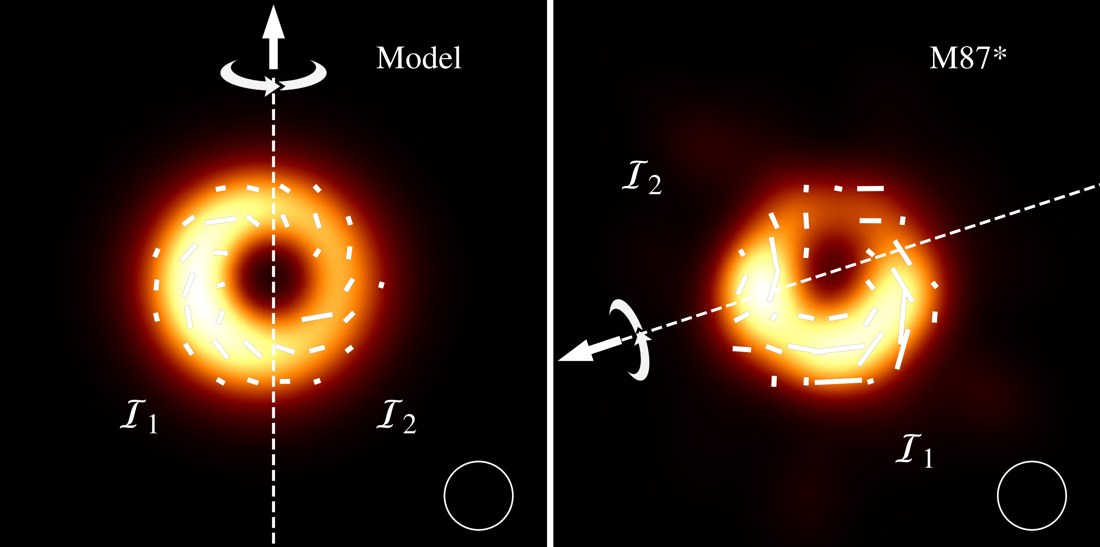 Reading the Magnetic Fingerprints of M87*
The first image of M87* could have been drawn by many different arrangements of gas and magnetic field. By comparing a large family of models with the polarised light, we found that the gas slowly spirals inward and that the field's shape can be read from the image.
All explainers ↗ All publications ↗