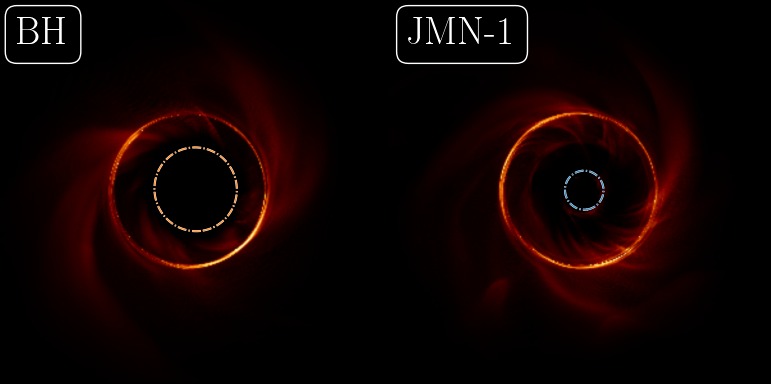
Here is an uncomfortable fact about black holes: we have never seen an event horizon. We have seen a shadow, and we infer the horizon behind it, rather like hearing footsteps and inferring a person. Usually that is a safe bet. Einstein’s theory, read carefully, allows another possibility.
The question
When a massive star collapses, general relativity does not insist that it forms a black hole. Under realistic conditions, the collapse can end in a compact object with no event horizon: no point of no return, nothing hidden behind a curtain. One such solution, the JMN-1 spacetime, is so compact that it bends light just like a black hole and casts a shadow of almost the same size.
So the question is simple to ask and annoyingly hard to answer: if M87* were one of these, would we know?
How we went about it
Earlier models had simply assumed how the gas behaves. This time we let the physics decide. We ran the first full three-dimensional simulation of hot, magnetised gas falling onto a horizonless object, with a black hole alongside it as a control, and let both evolve under the same laws. Then we traced the light from each and asked what a telescope would see.
What we found
- It survives. Gas settles into a steady, strongly magnetised flow around the horizonless object, much as it does around a black hole, and feeds it at a similar rate. Nature could, in principle, run this experiment.
- It hides well. At the sharpness of today’s telescopes, the two images are practically twins: the bright ring, the shadow, the overall look.
- It gives itself away inside. The difference lives in the darkest part of the picture. The horizonless object shows a smaller inner shadow and a faint glow from within it, light that a black hole would have swallowed for good.
That faint inner light is the clue. It sits just beyond what we can resolve today, but within reach of the next generation of instruments: the ngEHT, and the Black Hole Explorer in space.
A personal note
I do not believe M87* is a naked singularity. I simply think we should be able to say why not, with evidence rather than habit. A theory earns its confidence by surviving its best rivals, and this paper is my attempt to give one of those rivals a fair hearing. If the black hole wins, it wins properly.