Saurabh
Saurabh in a blue blazer and a decorated graduation hat, shrugging with a smile

Saurabh

Theoretical Astrophysicist · Postdoctoral Research Associate

I am a Postdoctoral Research Associate at AI3, a new research group within the BASP Lab at Heriot-Watt University in Edinburgh. Before moving here, I completed my PhD at the Max Planck Institute for Radio Astronomy in Bonn. I am currently working on TomoGrav, a project that brings together radio observations and AI-driven imaging to reconstruct the evolving, three-dimensional structure of plasma around M87* and Sagittarius A*. The ambition is to go beyond static images and create the first 3D movies of black hole environments, revealing how matter moves and changes over time. Read more about the project ↗

My research explores matter and light in the most extreme regions of spacetime. As a member of the Event Horizon Telescope Collaboration, I combine observations from its Earth-sized network of radio telescopes with theoretical models and numerical simulations to better understand black holes, their environments, and the nature of gravity.

Selected research

All research ↗
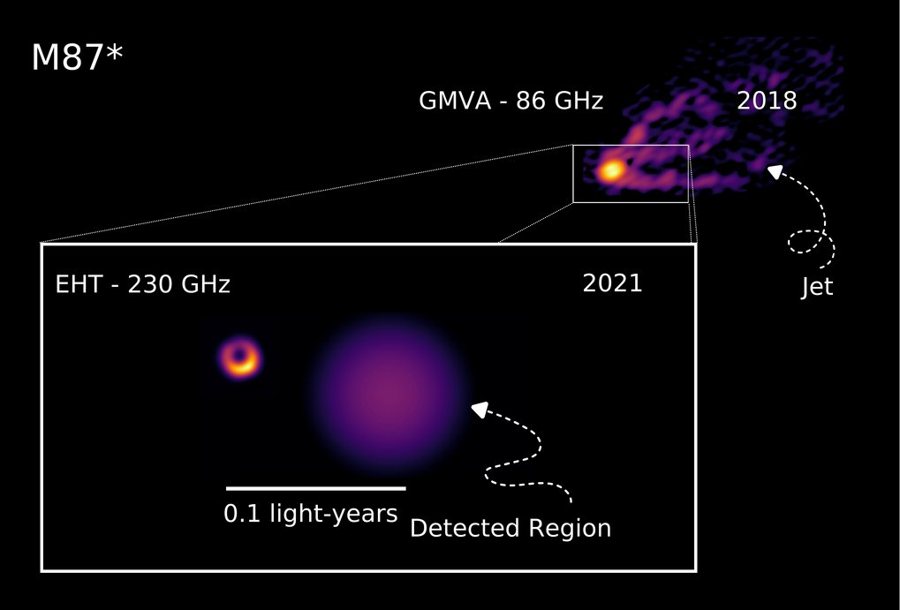
M87* at 86 GHz and 230 GHz, with the region of the detected jet-base component marked
M87* with the newly detected region marked. MPIfR press image, 2026

Where the jet of M87* begins

The 2021 EHT observations hold more than the bright ring. We found a faint, compact component about 0.09 light-years from the black hole, along the jet direction: a candidate for the jet's launching point.

Read the paper ↗
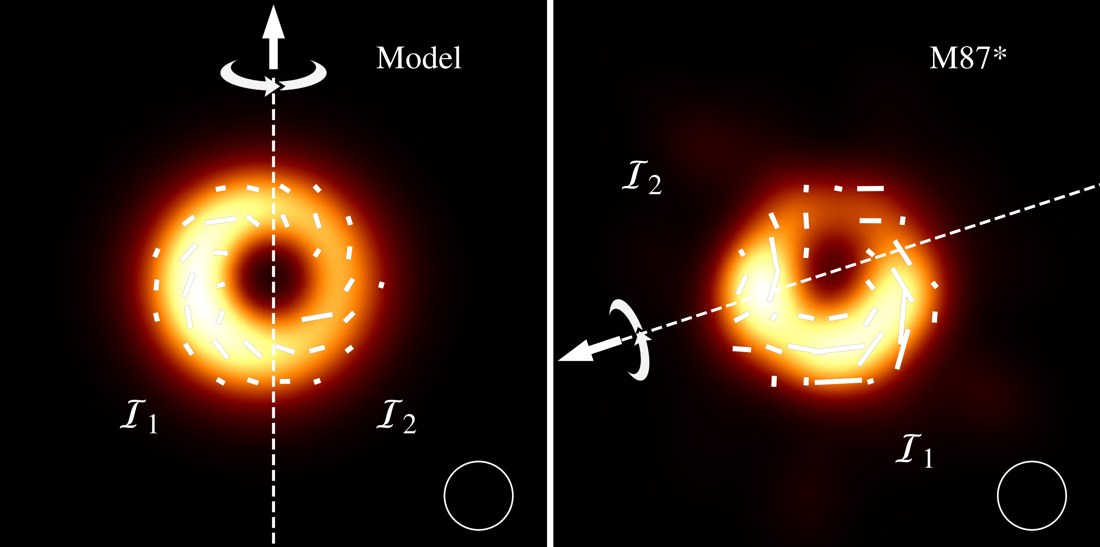
A ray-traced accretion model with polarization ticks beside the EHT 2017 image of M87*
A semi-analytic model (left) beside the EHT 2017 image of M87* (right)

Accretion flows and magnetic fields

How do the shape of the disk, the motion of the plasma and the geometry of the magnetic field set the ring we see? We compare polarized model images against EHT measurements to narrow down which configurations M87* allows.

Read the paper ↗
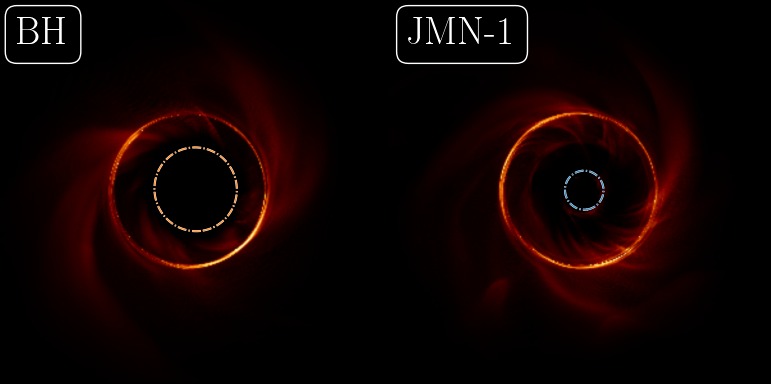
GRMHD snapshot images of accretion onto a black hole and onto the horizonless JMN-1 object
GRMHD snapshots: a black hole (left) and the horizonless JMN-1 object (right)

Is M87* really a black hole?

General relativity does not demand that collapse ends in an event horizon. It also allows horizonless objects, with no point of no return at all. I ran the first 3D GRMHD simulation of gas accreting onto one, the JMN-1 spacetime. At today's EHT resolution its image is almost indistinguishable from a black hole's. The difference hides inside the shadow, where the next generation of telescopes could look.

Read the preprint ↗

Simulations

How do you simulate matter falling onto a black hole, and what a telescope would see of it? I build up from simple analytic disks to full GRMHD, ray tracing each model through curved spacetime. The black hole behind this page is traced live in your browser.

How to simulate black hole accretion ↗
80°
30 M
Animated hotspot orbiting a Schwarzschild black hole
Orbiting hotspot
Animated thin disk seen at changing inclination
Novikov–Thorne thin disk
Animated ray-traced radiatively inefficient accretion flow
Semi-analytic RIAF
Animated GRMHD simulation of accretion onto a Schwarzschild black hole
GRMHD simulation

Science outreach

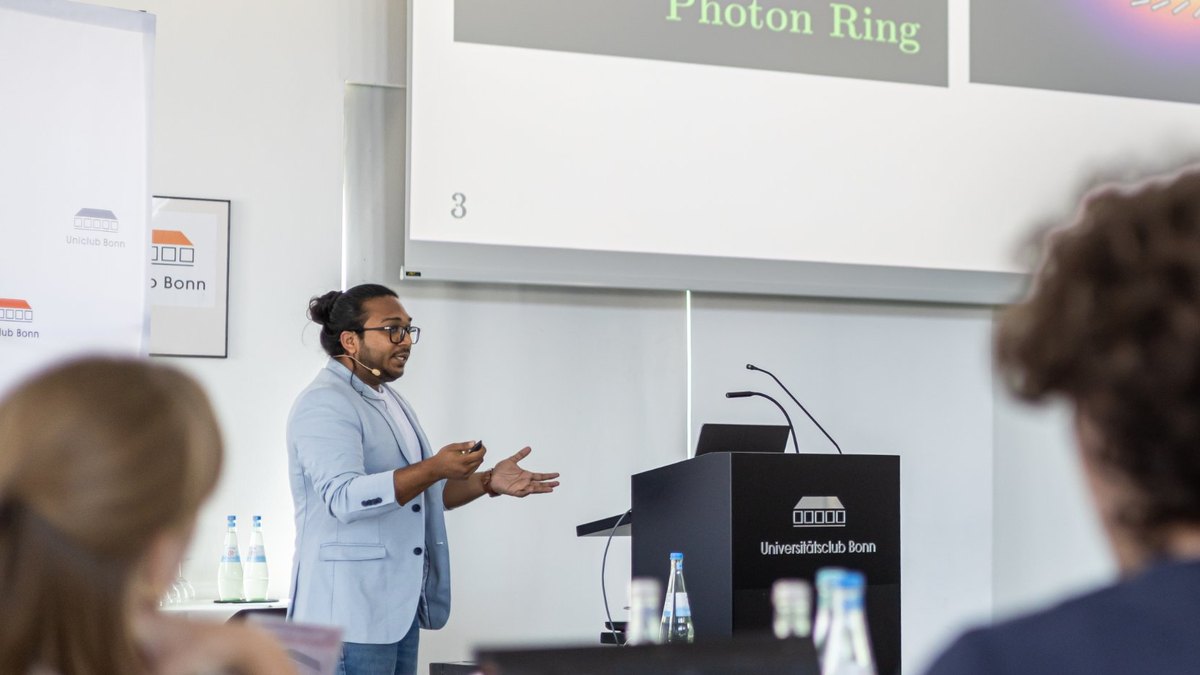
Saurabh giving a talk on black-hole images at the Universitätsclub Bonn
A talk on black-hole images at the Universitätsclub Bonn
“Besharmi dekho zaraa humari,
na door jaati hai, na fanaa hoti hai,
is bande ki pehli aur aakhri namaaz
aaj bhi wahin adaa hoti hai.”— Mansukhani, D.
  • Stellar Universe

    In 2017, with fellow students at Dyal Singh College, University of Delhi, I founded Stellar Universe to bring astrophysics and general relativity to students from the undergraduate level on, whatever their background. It grew from a group of friends into a network of more than 500 science enthusiasts in India and abroad, running free lectures, courses in general relativity, programming workshops and sky-watching sessions, with support from the Nehru Planetarium, Delhi.

  • Event Horizon Telescope

    I contribute to the EHT Collaboration's outreach and social-media work, and to the public communication of results on M87*.

  • Talks and short videos

    I give public and invited talks, and make short videos explaining how we image black holes.

    Watch on Instagram ↗

Journey

  1. Postdoctoral Research Associate

    AI3–BASP Laboratory, Heriot-Watt University, Edinburgh, United Kingdom

  2. Postdoctoral Fellow

    Max Planck Institute for Radio Astronomy, Bonn, Germany

  3. PhD in Astrophysicsmagna cum laude

    Max Planck Institute for Radio Astronomy, Bonn, Germany

    Read my thesis ↗
  4. MSc in PhysicsSpecialisation in Astrophysics and Cosmology

    International Centre for Cosmology (ICC), PDPIAS, CHARUSAT, Gujarat, India

  5. BSc (Hons) in Physics

    Dyal Singh College, University of Delhi, India

Out of the Box

It may seem that my world revolves around black holes. In a sense, it does. I spend much of my time either lost in thought or lost in the experience of living, though I have never been particularly good at separating the two. Curiously, my thoughts often lead me beyond the very science that inspires them. What does it mean to observe something whose defining boundary permits no light to return? If two fundamentally different spacetimes cast the same shadow, have we discovered the truth, or merely found an explanation that fits? Where does observation end and interpretation begin? That is where I find myself dancing on the thin line between science and philosophy, and, on braver days, dangling off the edge. Perhaps that is what draws me to the philosophy of science: the suspicion that understanding the universe and understanding what we can know about it are not quite the same endeavour.

But life cannot be lived entirely in thought (or maybe it can?), and not everything worth expressing lends itself to an equation.

Somewhere in the final months of my PhD, amid the rather complicated relationship with my thesis writing, I taught myself to play the bansuri, the Indian bamboo flute. It began as a modest escape from stress and gradually became something of a refuge. I make no claims to understanding the intricacies of classical music; I know little of its grammar, only something of its language. My encounters with the ghazal and the qawwali have turned music from something I hear into something I feel. Put simply: the ghazal is a medicine for the pain and misery of life; the qawwali is the ecstasy that carries one beyond them.

Whatever spills out of all this lands here: essays, poetry, photographs and more.


Feel free to get in touch

I usually reply faster than light can cross the event horizon of Sgr A*.

sbhkmr1999@gmail.com saurabh@mpifr-bonn.mpg.de

© 2026 Saurabh · Cookie settings